
听见你的声音
Real-life snake game: Giant python caught feasting on ducks in Fujian_我的网站

一 |
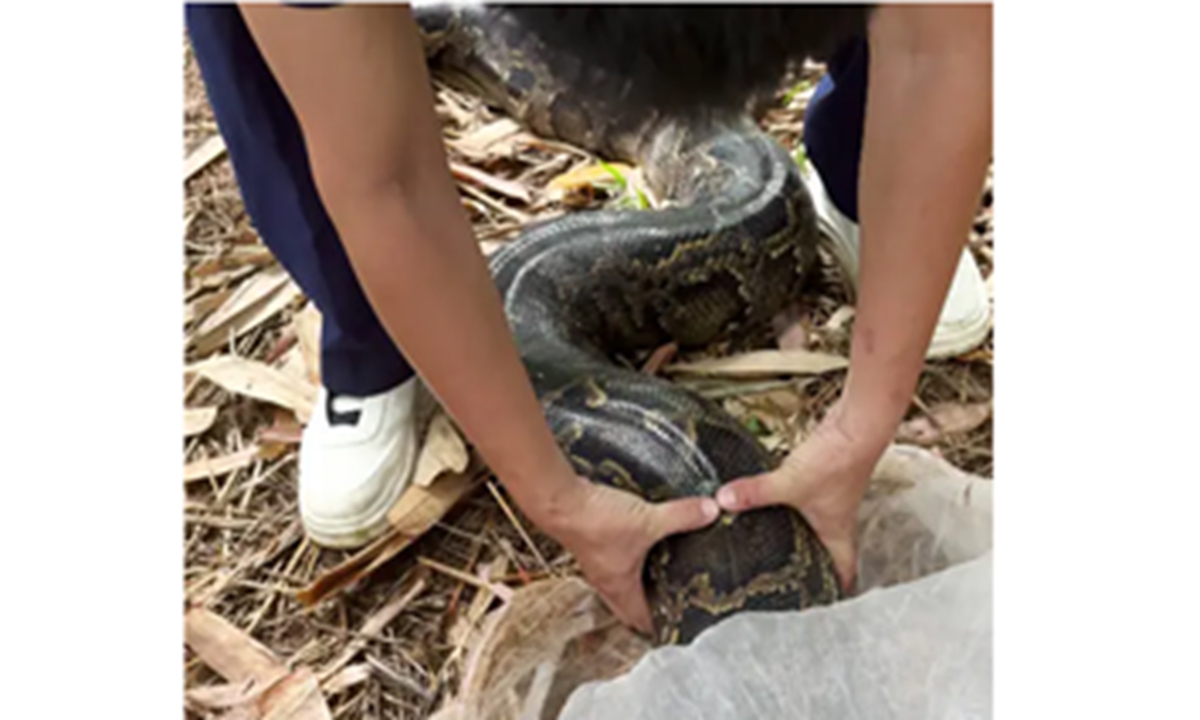
A local duck farmer discovered the python stealing ducks and called a local resident Chen out of fear. Chen recalled the serpent had already swallowed several ducks by the time he arrived, adding it "had a huge belly and must weigh over 50 kilograms."
Chen then turned to Liming rescue team, a professional local civilian rescue group. A team member surnamed Ye, who had joined the team for more than a year, took part in the rescue and said this was the largest python he had ever encountered, Jimu News reported.
Xu, head of the rescue center, was also on site that day. Video footage he shot showed the python, several meters long with sharp teeth, still trying to attack the rescuers even after being placed in a bag. "A python as big as this onecould easily swallow a lamb weighing dozens of kilos," Ye said.
Ye said the snake regurgitated three ducks whose carcasses had begun to decompose. After vomiting up the prey, the python escaped briefly before being tracked down and restrained in a nearby bamboo grove, according to the report.
Rescuers eventually transported the python to remote mountains far from residential areas and set it free, Jimu News reported.
Global Times
。 London, Oct 18 (UNI) "The Seven Moons of Maali Almeida" by Sri Lankan Shehan Karunatilaka, a supernatural satire set amid a murderous civil war in the island nation, has won the Booker Prize.
The novel is about a photographer who wakes up dead, with a week to ask his friends to find his photos and expose the brutality of war, BBC and other media reported.
Camilla, the Queen Consort, presented the prize, and the author said it had been "an honour and a privilege" to be on the shortlist.
Karunatilaka said as he accepted his prize: "My hope is that in the not too distant future... Sri Lanka has understood that these ideas of corruption and race-baiting and cronyism have not worked and will never work."
The writer said he decided in 2009 to write "a ghost story where the dead could offer their perspective" after the end of the Sri Lankan civil war, "when there was a raging debate over how many civilians died and whose fault it was".
"I hope it's in print in 10 years... if it is, I hope it's written in a Sri Lanka that learns from its stories, and that Seven Moons will be in the fantasy section of the bookshop, next to the dragons, the unicorns and will not be mistaken for realism or political satire," the BBC reported
He added that he had "self-censored" a couple of short stories after author Salman Rushdie was stabbed in August, having faced years of death threats for his novel "The Satanic Verses", which some Muslims see as blasphemous.
"I was in the process of publishing a collection of short stories when this incident happened, and I discovered a couple which I don't think was offensive to any religion," Karunatilaka said.
"But my wife said, can you not do that? You've got two young kids. This story is not that good. Just leave it out."
He added that "this is something that hangs over all of us if we're writing in South Asia, especially writing about politics or religion", the BBC said.
Head judge Neil MacGregor praised the "scope and the skill, the daring, the audacity and hilarity" of the novel, calling it an "afterlife noir" which "takes the reader on a rollercoaster journey through life and death".
He said the judges' decision had been unanimous, adding all of the shortlisted books were "all really about one question, and that is what's the point of an individual life?"
The prestigious £50,000 prize, for a single work of fiction published in the UK in English, also gives the other five writers on the shortlist £2,500 each.
"The Seven Moons of Maali" is Karunatilaka's second novel, having previously won awards including the Commonwealth Book Prize for his debut book Chinaman, which was called the "second best cricket book of all time" by cricketers' almanac Wisden.
Born in 1975, the writer has also worked as an advertising copywriter, and his songs, scripts and stories have been published in Rolling Stone, GQ and National Geographic.
MacGregor, a former director of London's National Gallery and the British Museum, added that the judges read all 170 books put forward for the prize, then whittled them down to 30. They then re-read those, before deciding on the final six, which they read for a third time, the report said.
The other nominees were: "Glory" by NoViolet Bulawayo, "The Trees" by Percival Everett, "Treacle Walker" by Alan Garner, "Small Things Like These" by Claire Keegan and "Oh William!" by Elizabeth Strout.
The Booker-winning novel tells the story of the photographer of its title, who in 1990 wakes up dead in what seems like a celestial visa office. With no idea who killed him, Maali has seven moons to contact the people he loves most and lead them to a hidden cache of photos of civil war atrocities that will rock Sri Lanka, the Daily Mirror reported.
The judges were unanimous in their decision to award the prize to Karunatilaka, according to the chair.
Receiving his prize, Karunatilaka addressed the people of Sri Lanka in Tamil and Sinhalese. He summarised what he said in English: “I write these books for you… Let’s keep sharing these stories.”
The Seven Moons of Maali Almeida is published by the independent press Sort of Books. This year is the first time a book by the publisher has been longlisted for the prize.
Karunatilaka has become the second Sri Lankan-born author to win, following Michael Ondaatje, who won in 1992 with "The English Patient".
In his Guardian review, Tomiwa Owolade said the book’s “scenarios are often absurd … but executed with a humour and pathos that ground the reader”. He added: “Karunatilaka has done artistic justice to a terrible period in his country’s history.”
Karunatilaka, was born in Galle, Sri Lanka, in 1975 and grew up in Colombo.
UNI MR。
Current article:http://hoyho.shouyouxumianpouluanteng.shop/list_5c7/qg34.html
Published on:00:50:00
我的网站相关内容
 日本妈妈劝儿子别怕死,笑中国母亲软弱,原子弹落下那天在想什么,叶苍茫2022,原创 日本妈妈劝儿子别怕死,笑中国母亲软弱,原子弹落下那天在想什么
 方寸之间见民生——体彩公益金“圈”出资溪人的幸福生活
 浙江宁波舟山港绿色甲醇燃料加注实现“三级跳”,浙江宁波舟山港绿色甲醇燃料加注实现“三级跳”
 沙巴巴库2017年建队,成为建队最晚的欧冠正赛球队
 辽宁省工商联民营经济研究智库成立
 中国农科院启动实施重大科技任务助力乡村建设
- ·先领教了歼-10C,又见识了歼-16,埃及空军恐怕会对F-16V失去兴趣,锋芒点兵,原创 先领教了歼-10C,又见识了歼-16,埃及空军恐怕会对F-16V失去兴趣
- ·老詹经纪人:哈登提前看清快船局势选择离开 必须为这手操作点赞
- ·时隔5个月,电池级碳酸锂冲上50万元/吨!机构预计9月供需缺口达6000吨,业绩翻倍股名单来了_产能_数据
- ·新赛道孕育新机遇 未来产业激荡发展新动能
- ·为明年启动出海铺路,小米汽车海外账号、官网正式上线
- ·两部门急拨8000万元支持豫鄂皖应急抢险救灾
- ·大学生在网上预约时被出租车司机吓坏了。交通管理部门:已实施执法
- ·奥克兰北岸路上有一名男子死亡!死因不明,警方正在调查
我的网站最新内容
- ·央视《焦点访谈》关注丨在秦皇岛沉浸式体验“中国酷”
- ·华光新材:上半年归母净利润9171.74万元,同比下降25.56%
- ·抄底好时机?10万块的君威值不值得买?
- ·垒知集团:上半年净利润5779.36万元,同比下降12.18%
- ·以党建为引领 推动抚顺文艺事业繁荣发展 ——抚顺市文联成立70周年文艺工作综述之一
- ·突然大涨!马斯克突传重磅利好 特斯拉无人驾驶电动车Cybercab发布会定档
- ·首期亚太经合组织清洁能源高级研修班在福州举办
- ·China's cooperation powers green future in Global South
- ·From joint ventures to joint innovation: Why global autos look to China
- ·看似“馅饼”实则“陷阱” 别被低价装修套餐忽悠了
- ·The Witcher 3 资料片 Songs of the Past 确认将包含更多 巫师之昆特牌 内容,玩家们已纷纷开始庆祝。
- ·记者:穆里尼奥能为每场失利找到托词,但现在只剩签署辞职信
- ·talksport:雷克瑟姆即将以200万镑,自曼城签下后卫伊萨・卡博雷
- ·新华解码丨如何培育国家级零碳工厂、零碳算力设施
- ·高盛揭秘10万亿美元AI持仓版图 对冲基金与共同基金有哪些不同?
- ·车市需求“预冷” 特斯拉三季报敲响“警钟”:华尔街警告汽车行业或由盛转衰
我的网站热点内容
- ·售53.66万元起 长城G系列混动重卡G1050正式上市
- ·四川黄龙景区就“牦牛闯入五彩池”致歉!曾有人下水捡无人机
- ·受强降雨影响 南铁启动防洪Ⅲ级应急响应 动态调整开行方案
- ·IT之家Android 6.60发布:评论/文章、精读专栏、黑房子在线
- ·沪指低开0.20%农业、石油板块回调
- ·上海:扩大铜、铝等重点金属品类交易规模,加快健全锂、钴、镍等新兴金属期货品种序列
- ·今年三伏为1961年以来第五热!四川气温持续偏高,局地有大雨、暴雨、雷暴大风
- ·差距非常悬殊!半场比拼火箭有7个前场篮板 勇士0个
- ·克莱:当年为防止伤腿肌肉萎缩 我做了大量的单腿深蹲和提踵训练
- ·苹果全新 Mac mini 发布:可选 M6 或 M5 Pro 芯片,6999 元起售
- ·商家代练服务开挂,导致买家账号封号
- ·四位梅花奖得主联袂揭幕 “河北礼物”钟馗IP形象重磅发布
- ·Historians Figure Out How Ancient Sailors Navigated Mediterranean By Building One of Their Ships
- ·不容易!国乒男单首轮终于赢球,2位小将立功,1/8决赛再迎生死战
- ·苹果为iPhone发布了三款新的智能电池保护器:Qi无线充电
- ·2026年加快建设交通强国大会召开